
GLP-1s: The Next Phase Begins
In our previous blog, “GLP-1: From Diabetes Niche to Obesity Blockbuster – The Next Pharma Supercycle”, we discussed how GLP-1 therapies were reshaping diabetes and obesity treatment. Since then, annualized GLP-1 sales have scaled to ~US$89 billion by Q1CY26, reinforcing the magnitude of the opportunity.
However, a new phase is now emerging. Semaglutide — the molecule behind Ozempic and Wegovy — has begun losing exclusivity across several emerging markets during 2026. This shift from an innovator-led market toward generic competition could become the next major inflection point for GLP-1s, improving affordability, expanding access, and accelerating market penetration.
The Worldwide GLP-1 Boom Has Just Begun
Over the past decade, the GLP-1 therapeutics market has expanded from a ~US$2 billion category in CY14 to an annualized ~US$89 billion market by Q1CY26, marking one of the fastest growth trajectories in global pharmaceuticals. A key inflection point came with the approval of Wegovy for obesity in 2021, which expanded the addressable market well beyond diabetes and accelerated the mainstream adoption of GLP-1 therapies.

Expanding the Reach of GLP-1
Despite the strong clinical success of GLP-1 therapies, global penetration remains materially underpenetrated relative to the addressable market.
· Over 550 million people worldwide live with diabetes, with >90% residing outside the US, yet GLP-1s account for only ~8% of global diabetes prescriptions.
· Similarly, while obesity impacts more than 900 million people globally, only ~1% of patients currently receive branded anti-obesity therapies.
The key constraint remains affordability and access, particularly across emerging markets where innovator-led penetration is limited by pricing and distribution reach. As a result, a significant proportion of the eligible patient population remains underserved despite robust demand and strong efficacy outcomes.
The onset of generic competition in semaglutide is expected to be a major inflection point, driving lower treatment costs, improving accessibility, and enabling broader adoption across emerging markets.

While Novo Nordisk retains Semaglutide patent protection in major developed markets such as the USA, EU and Japan through 2031–2032, the molecule has already begun losing exclusivity across 80+ countries due to differing patent frameworks and rejection of patent extension applications in several jurisdictions. Key markets where Semaglutide has gone off-patent include Canada (Jan’26), Brazil, China, and India (March’26).

India’s GLP-1 Market Enters a New Growth Phase Post Patent Expiry
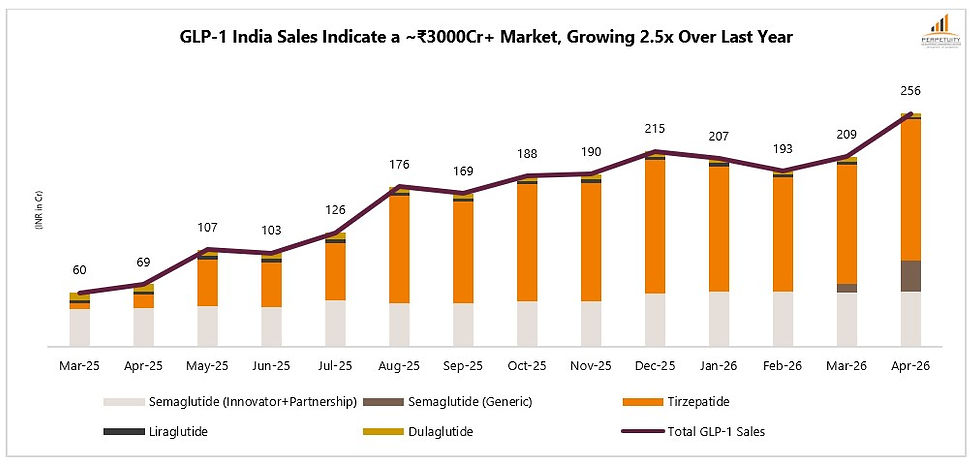
India represents one of the most attractive markets for GLP-1 therapies. With Semaglutide losing exclusivity in 2026, improved affordability is expected to drive significantly broader adoption, creating a multi-billion-dollar opportunity for Indian pharmaceutical companies.
Before we delve further…
Why India Became One of the First Markets Where Semaglutide Went Off-Patent:
India emerged as one of the earliest markets for generic Semaglutide due to its strict 20-year patent regime, which does not permit patent term extensions or Supplementary Protection Certificates (SPCs). In addition, India’s limited scope for evergreening restricted Novo Nordisk from extending exclusivity through secondary patents linked to formulations, delivery systems, or stability enhancements.
Semaglutide in India was protected primarily through two patents:

Semaglutide’s core molecule patent expired in September 2024, while the formulation and delivery patent — the key blocking patent — expired in March 2026, effectively creating the real patent cliff for the product in India. Although Indian companies were permitted to manufacture APIs and pursue exports after 2024, domestic commercialization remained restricted following legal action by Novo Nordisk and subsequent Delhi High Court directives. With the expiry of the formulation patent in March 2026, the Indian market has now opened for full-scale generic commercialization, creating a significant opportunity for domestic pharma players.
The Boom in India Semaglutide Market: It’s Just the Beginning…

Following Semaglutide’s patent expiry in March 2026, India saw rapid ramp-up of generics, with 27 brands launched by 14 companies within just 40 days.
· The launch materially expanded the market, with Semaglutide sales rising ~1.5x from ~₹61 crore in Jan/Feb’26 to ~₹95 crore in Apr’26, implying an annualized market size of ~₹400Cr.
· Volumes grew even faster, from ~157k units in Jan’26 to ~288k unit in Apr’26, highlighting strong demand elasticity driven by improved affordability.
· Generics captured ~36% value share and ~49% volume share within 40 days, aided by pricing discounts of 50-90% to innovator brands. Importantly, innovator sales and volumes remained broadly stable at pre-generic levels, indicating that generics are expanding the overall GLP-1 market by onboarding new patients.
· Within the generic semaglutide market, Torrent emerged as the leader with ~34% value share and ~35% volume share in Apr’26, while Eris Lifesciences ranked second with ~11% value share and ~17% volume share

Quantifying GLP-1 India Market Opportunity

While diabetes has been the primary adoption driver for GLP-1 therapies, obesity represents a significantly larger long-term opportunity given its substantially broader addressable population. With GLP-1 penetration in the US estimated at ~21% (per Novo Nordisk Q1CY26 presentation), and assuming a similar ~20% penetration trajectory for India over time, the combined diabetes and obesity segments could translate into a potential GLP-1 patient pool of ~96 Lakh in India, underscoring a multi-billion-dollar market opportunity.Top of Form
Of the estimated ~9.6 million addressable GLP-1 patient pool in India, we assume innovator brands retain ~5% share, while generics capture the remaining ~95%, implying a potential ~9.1 million patients on generic GLP-1 therapies. While actual adoption will depend on affordability, reimbursement, physician acceptance and patient persistence, the analysis highlights the scale of the long-term opportunity.
· At pricing level of ~₹4,000 per month (similar to current pen pricing), the combined innovator and generic GLP-1 market opportunity could scale to ~₹50,000Cr.
· Even under a sharper price normalization scenario, with generic pricing declining toward ~₹1,000 per month (similar to current vial pricing), the overall GLP-1 market opportunity would still be comparable in size to India’s existing anti-diabetic market.
· Highlighting the massive long-term volume potential driven by affordability-led penetration.

Canada Emerges as the First G7 Generic GLP-1 Market
On 28 April 2026, Dr. Reddy's Laboratories received approval from Health Canada for Canada’s first generic semaglutide injection, with Apotex being the only other approved filer out of 9 applicants under review.
The Patent Lapse That Changed the Market: In 2019, Novo failed to pay a CAD250 maintenance fee associated with Canadian patent covering semaglutide, leading to loss of exclusivity.
Why Canada is Strategically Important in GLP-1s:
According to the Public Health Agency of Canada:
~3.9 million Canadians live with diagnosed diabetes)
> 6% of adults live with prediabetes
Diabetes prevalence is expected to rise further with aging demographics
At the same time, semaglutide adoption has scaled rapidly:
· Ozempic generated ~CAD 2.9 billion in Canadian sales during 2025, becoming the single best-selling drug in Canada.
· >1 million Canadians are currently using the therapy.
Canada is estimated to be among the largest semaglutide markets globally, making generic entry commercially significant despite its smaller population relative to the USA.
Generic Competition to Drive Access Expansion
With generic drugs in Canada typically priced 45–90% below branded therapies, generic semaglutide is expected to materially improve affordability and expand GLP-1 access. The initial market structure is likely to remain relatively disciplined, with competition limited to Novo Nordisk and 2 approved generic players during the early phase before additional entrants receive approvals.
The Canadian GLP-1 market is broadly split across:
· Public reimbursement
· Cash-pay
· Private insurance
Each segment contributes roughly one-third of the market, although reimbursement-led pricing pressure is expected to gradually intensify over time. Given the innovator’s already established presence, lower-priced generic products are expected to initially target the public reimbursement segment, where affordability-driven adoption could accelerate most rapidly.
Brazil GLP-1 Transition: First Generic Approval Marks New Phase
Brazil’s GLP-1 market has entered a pivotal transition phase following the expiry of Novo Nordisk’s semaglutide patent in March 2026, after Brazil’s Superior Court rejected attempts to extend exclusivity.
ANVISA approved the country’s first generic semaglutide from EMS on 26-May-2026, just ~2 months post patent expiry, providing an early validation of the regulatory pathway for generic GLP-1s. Brazil currently has ~14 semaglutide applications under review, with approvals expected to accelerate following the US FDA’s acceptance of semi-synthetic semaglutide pathways. However, ANVISA has also demonstrated a stringent regulatory stance, rejecting 3 GLP-1 generic applications from Indian drugmakers in April’26 for failing to meet efficacy, safety and quality requirements.
The market is estimated at ~BRL10bn (~US$1.9bn) and growing 15–30% YoY, though manufacturer-level opportunity could currently be closer to sub-US$1bn. EMS plans to launch Ozivy at ~30% discount to Ozempic with capacity of up to 40mn pens annually, targeting >1mn pen sales and >BRL500mn (USD100mn) revenue in year one. Unlike India, price erosion in Brazil is expected to be gradual, potentially reaching 60–70% over 12–18 months.
Novo Nordisk is also defending the market aggressively with US$1.09bn capex expansion at its Montes Claros facility, while players including Hypera, Biomm, DRL, Sun, Cipla, Biocon and Torrent remain in the filing queue.
GLP-1: Evolving into a Multi-Disease Therapy Platform
GLP-1 therapies are evolving beyond diabetes and obesity into multi-therapeutic drugs with benefits across cardiovascular, renal, liver, sleep apnea, and neurodegenerative diseases. Clinical data has shown reductions in cardiovascular events, improvements in MASH/NASH, and positive outcomes in chronic kidney disease, positioning GLP-1s as potential disease-modifying therapies rather than purely metabolic drugs. This expanding therapeutic relevance could materially broaden the addressable market, drive long-term adoption, and create significant incremental opportunities for both innovators and generic players.


The combination of expanding clinical utility, improving affordability, and increasing generic availability could make GLP-1 therapies one of the largest pharmaceutical categories globally over the coming decade. For India, the combination of a large, underserved patient pool and the emergence of generic competition could make GLP-1s one of the most significant pharmaceutical opportunities of the coming decade.


Comments